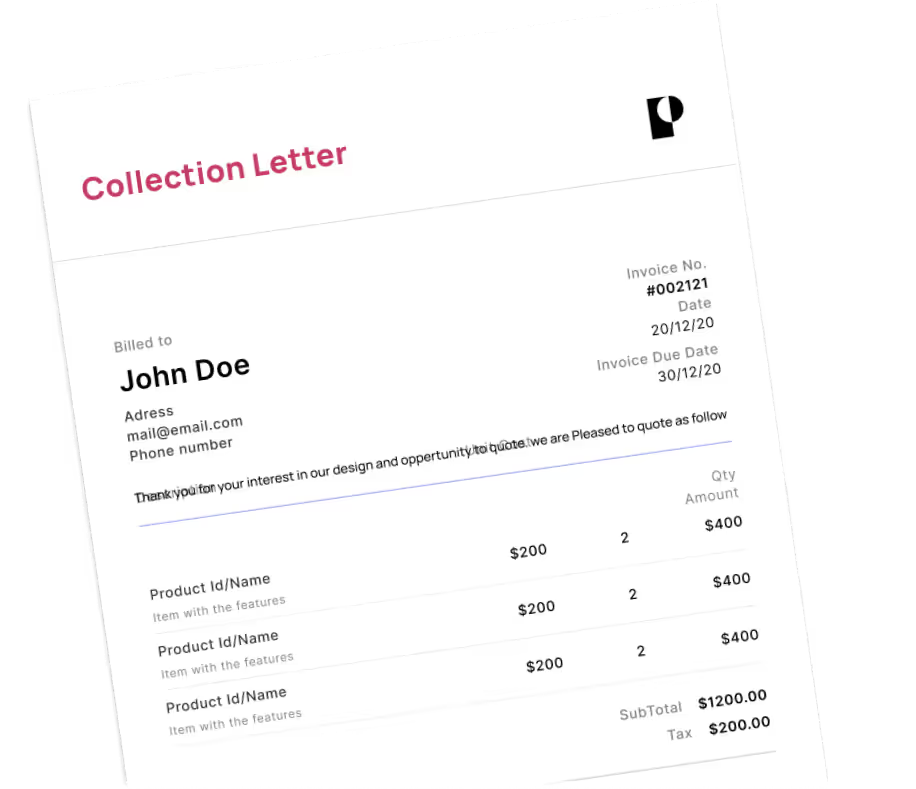
Debt Collection Agency in India - No Win, No Fee
Your claims are handled exclusively by GCS Management Solutions, our registered Indian debt recovery partner (rin vasuli) with 16+ years of expertise.


Get free expert advice
Response from a specialist within 24 hours.
Why Choose Debitura for Debt Collection in India
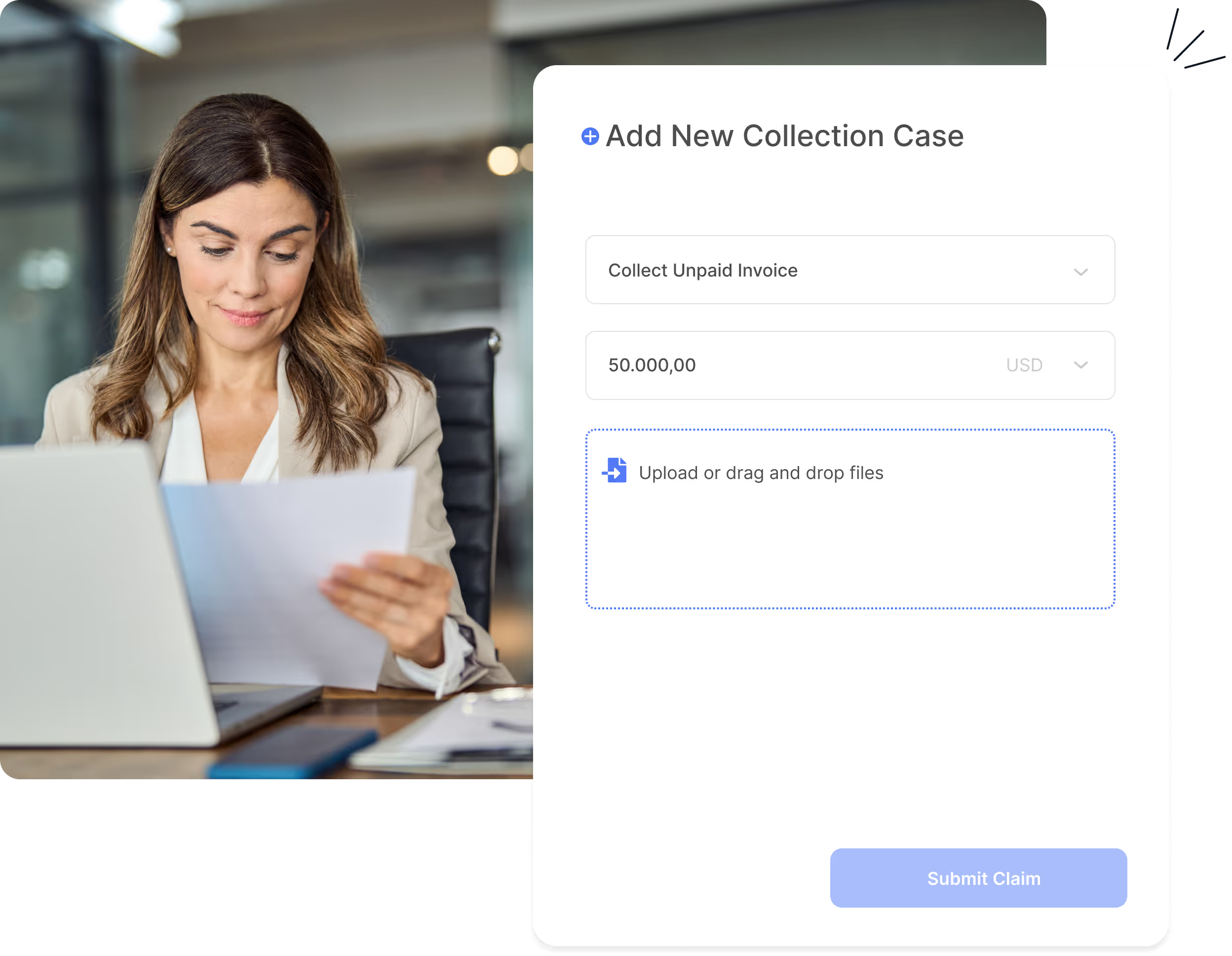
Fast, simple and risk-free debt collection in India
Debitura recovers unpaid invoices from debtors in India through our platform: submit your claim, and we assign it to a licensed local partner working on a No Cure, No Pay basis while you track progress in real time. Your case is handled by GCS Management Solutions, a Gurugram-based debt recovery specialist with 16+ years of experience serving transnational banks, credit insurers, and multinational corporations across India.
- Risk-free: Pay only when we recover your money.
- Quick setup: Submit invoices in a few clicks.
- Real-time tracking: Monitor progress live in one portal.
- Local expertise: Registered Indian professionals handle everything.

Start recovering your Indian debts in three steps
- Upload your claim: Enter debtor details and upload invoices through our secure portal. Takes about 2 minutes.
- We take over: GCS Management Solutions contacts your debtor within 24 hours using local expertise and language.
- Get paid: Recovered funds are transferred directly to your account. You only pay our success fee when we collect.
Already using SAP, Oracle, or another ERP? Connect via API or Zapier for automated claim submission and status updates.
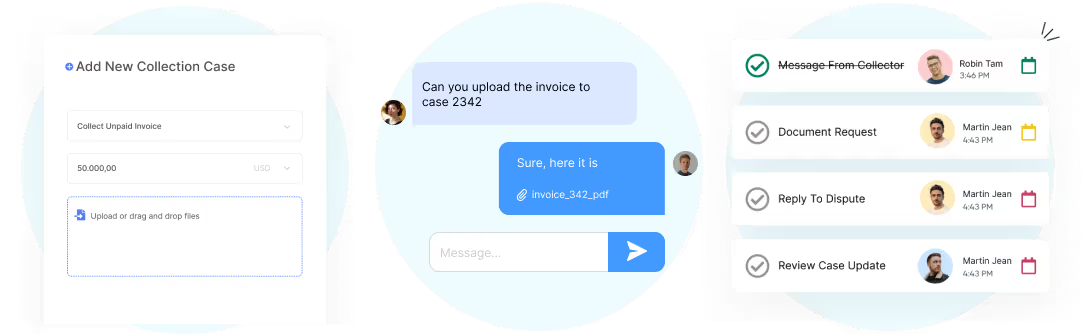

Transparent, success-based pricing
With Debitura you only pay when we succeed. Pre-legal collection is No Cure, No Pay: a success fee deducted from recovered amounts, invoiced locally by your partner. Fees depend on the debtor's country, not yours.
- Debtors in Europe (EU, Iceland, Liechtenstein, Norway, the UK and Switzerland): success fees from 6% depending on claim size.
- Debtors in the rest of the world: success fees from 7.5% depending on claim size.
- Older claims: a surcharge applies for claims 12–24 months overdue and for claims older than 24 months.
- Legal action is optional: you approve fixed-price quotes before any legal spend.
See the pricing page for the full fee schedule, or get an instant estimate when you upload a claim.
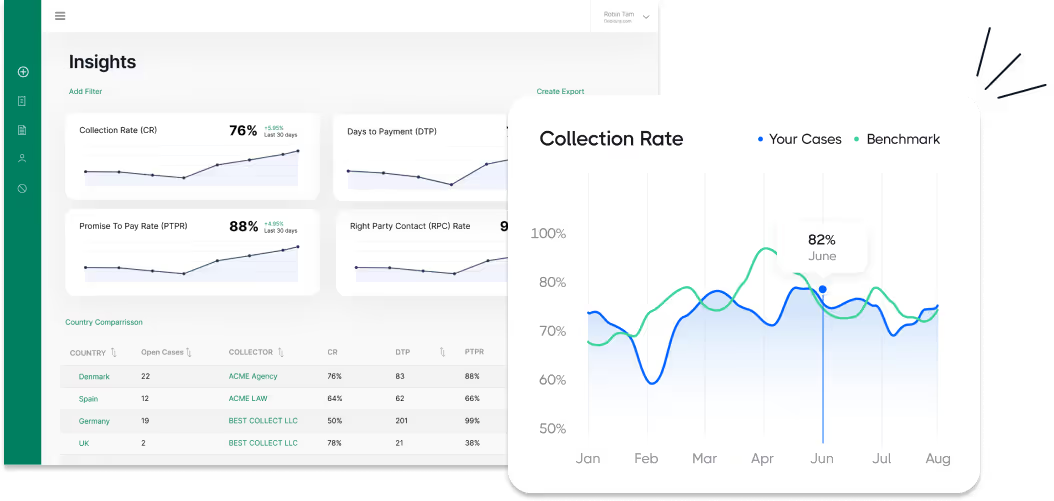
How does debt collection work in India?
Debt collection in India starts with an amicable phase handled locally by GCS Management Solutions India Pvt Ltd: reminders and a formal demand for payment, aimed at full payment or a written acknowledgement of the debt. Most undisputed claims are resolved at this stage. If the debtor still does not pay, escalation is never automatic; your partner assesses the legal route, and you approve a fixed-price quote before any court step.
- Most debts resolve within 30-60 days through amicable collection.
- 3-year limitation period for contract claims under India's Limitation Act, 1963.
- Optional escalation to Summary Suit (Order 37 CPC) for fast-track recovery.
- Enforcement through court attachment and sale of assets.
The four steps from unpaid invoice to recovered cash
- Step 1, Amicable collection: reminders, a formal demand and negotiation, handled locally by GCS Management Solutions India Pvt Ltd. Most undisputed claims are resolved here, without going to court.
- Step 2, Enforceable title: if the debtor still does not pay, your partner assesses the legal route to obtain a court decree, and you approve a fixed-price quote before anything proceeds.
- Step 3, Enforcement: with a decree, the court's execution machinery can attach and sell property, garnish bank accounts and other debts, and in limited cases arrest the debtor until the claim is recovered.
- Step 4, Insolvency: if the debtor is a company that cannot pay, your proof of claim is filed in the insolvency process, and any distributions are monitored on your behalf.
Every step is tracked in your dashboard, and nothing escalates without your approval. The full legal detail for India, covering timelines, costs, courts and enforcement, follows in the guide below.

Debt collection in India - the complete 2026 guide
Debt collection in India (also searched as payment recovery or money recovery) is set out here end to end for overseas and domestic creditors, in-house counsel and finance teams: the legal framework, who does what, limitation and interest rules, the special protections for small suppliers, the routes to a court decree, enforcement under the Code of Civil Procedure, and corporate insolvency under the Insolvency and Bankruptcy Code.
On this page:
Why you can trust this guide
At Debitura, we uphold the highest standards of impartiality and precision to bring you comprehensive guides on international debt collection. Every guide is written from primary legal sources and reviewed by licensed local experts in the jurisdiction it covers.
Questions or feedback? Email us at contact@debitura.com , we update this guide based on your input.
Debitura By the Numbers:
- 767 licensed partners - collection agencies and law firms in our network
- 180 countries covered - with cases handled in 174 of them
- 5,306 businesses registered with Debitura
- 33 days median time to first payment on European cases
Expert-led, locally validated
Written by Lars Holdgaard, Founder of Debitura (+10 years in global B2B debt recovery). Every page is reviewed by top local attorneys to ensure legal accuracy and practical steps you can use.

Contributing local experts:
Last updated:

Debt collection in India - quick answers
Whether you call it debt collection, payment recovery or money recovery, the right route in India depends on the size and nature of the debt and on the debtor. The headline rules are below.
How much does debt collection cost in India?
Pre-legal collection is commonly success-based (No Cure, No Pay), so the creditor pays only on recovery. Court action is separate: the creditor advances an ad valorem court fee set by the relevant state's own Court Fees Act, 1870 schedule, plus advocate fees; under Section 35 of the Code of Civil Procedure the court has discretion to award costs to the successful party.
How long does debt collection take in India?
Amicable recovery of an undisputed debt typically runs a few weeks to a couple of months. A summary suit on a written debt is faster than an ordinary suit because the defendant must first obtain leave to defend. A delayed-payment reference by a registered micro or small supplier to the state facilitation council is to be decided within 90 days, and corporate insolvency should ordinarily complete within 330 days.
What are the limitation periods and interest rules in India?
A suit to recover a contract or simple money debt must generally be filed within three years of the due date (Limitation Act, 1963, Schedule Part I, Article 1). A written, signed acknowledgement of the debt made before the period expires (Section 18) or a part-payment (Section 19) starts a fresh three-year period. A court decree is enforceable for twelve years (Article 136). Pre-decree interest runs at the contractual rate or the court's discretion under Section 34 of the Code of Civil Procedure; post-decree interest is capped at 6% a year unless the debt arises from a commercial transaction, where it can run higher. Registered micro and small suppliers have a stronger statutory entitlement (see below).
| Topic | Rule |
|---|---|
| Contract / money debt | 3 years from the due date; resets on a written, signed acknowledgement or part-payment. |
| Enforcing a decree | 12 years from the date the decree becomes enforceable. |
| Pre-decree interest | Contractual rate, or the court's discretion (CPC s.34). |
| Micro / small supplier | Payment within 45 days; on delay, compound interest at 3x the RBI-notified bank rate (MSMED Act, 2006, ss.15-16). |
| Dishonoured cheque | Statutory notice within 30 days of dishonour; complaint under s.138 Negotiable Instruments Act, 1881. |
Is there a faster route for small suppliers in India?
Yes. A registered micro or small enterprise can refer a delayed-payment dispute to its state Micro and Small Enterprises Facilitation Council (the MSEFC), which is to decide the reference within 90 days and whose award is enforceable like a decree.
What documents do I need to collect a debt in India?
Assemble the contract or purchase order, the unpaid invoices and statement of account, proof of delivery or performance, all correspondence, and any written acknowledgement of the debt or dishonoured cheque. For a company creditor, evidence of authority to act is expected in formal proceedings.
Which route should my claim take in India?
An undisputed debt on a written contract, bill of exchange or promissory note suits a summary suit (Order XXXVII, Code of Civil Procedure). A registered small supplier chasing a delayed payment can use the MSEFC route. A commercial dispute at or above the specified value (a national floor of ₹3,00,000, which some states notify higher) goes to a Commercial Court after mandatory pre-institution mediation. Where a company cannot pay an operational debt currently applied at ₹1 crore or more, the Insolvency and Bankruptcy Code route before the National Company Law Tribunal is available; see Step 4 for the 2026 reform to this Code, parts of which are still working through implementation.
Who does what in India debt collection?
Recovery in India involves collection agencies for amicable work, advocates for court and tribunal proceedings, and the courts' own execution machinery for enforcement. Debitura supports you across all stages through GCS Management Solutions India Pvt Ltd.
Debt collection agencies in India
Agencies handle the pre-legal, extrajudicial phase: contacting the debtor, issuing demands and negotiating settlement. There is no dedicated national licensing regime for business-to-business collection agencies; recovery agents acting for banks and non-banking financial companies must follow the Reserve Bank of India's Fair Practices Code, which governs regulated lenders' own loan recovery rather than general commercial trade-debt collection.
Advocates in India
Advocates, enrolled under the Advocates Act, 1961, represent creditors in the civil and commercial courts and before the National Company Law Tribunal. They draft and file suits, seek interim attachment, conduct execution, and act in insolvency applications. Legal representation is required for most formal proceedings.
Courts, tribunals and the facilitation council in India
The civil and commercial courts issue and execute money decrees; execution under Order XXI carries out attachment, sale and garnishee orders through court officers. The National Company Law Tribunal is the adjudicating authority for corporate insolvency under the Insolvency and Bankruptcy Code, and the Micro and Small Enterprises Facilitation Council handles registered small-supplier delayed-payment disputes. Debts Recovery Tribunals under the Recovery of Debts and Bankruptcy Act, 1993 exist mainly for banks' and NBFCs' own secured lending recovery, not typical unsecured B2B trade debt.
Which laws and courts apply to debt collection in India?
Debt recovery in India runs on a codified civil-procedure system, supplemented by commercial-court, limitation, small-supplier, insolvency and negotiable-instruments legislation.
The civil court system in India
Money claims are filed in the District or City Civil Courts by pecuniary and territorial jurisdiction; the exact pecuniary threshold for Small Causes Courts varies by state and should be confirmed locally. Commercial disputes of a "Specified Value" (a national floor of ₹3,00,000, which a State Government may notify higher for its High Court) are heard by Commercial Courts and the Commercial Divisions of the High Courts under the Commercial Courts Act, 2015 (as amended 2018, and further reformed procedurally in 2026). Corporate insolvency is decided by the National Company Law Tribunal, and small-supplier delayed-payment disputes go to the Micro and Small Enterprises Facilitation Council.
Key legislation in India
- Code of Civil Procedure, 1908: the suit process, summary suits (Order XXXVII) and execution of decrees (Order XXI).
- Limitation Act, 1963: the three-year limitation for contract debts and twelve years to enforce a decree.
- Commercial Courts Act, 2015: specialised courts and mandatory pre-institution mediation for commercial disputes.
- Micro, Small and Medium Enterprises Development Act, 2006 (the MSMED Act): protected payment terms and interest for registered micro and small suppliers.
- Insolvency and Bankruptcy Code, 2016, as substantially amended by the Insolvency and Bankruptcy Code (Amendment) Act, 2026 (assented 6 April 2026, most provisions in force from 26 May 2026): corporate insolvency initiated by operational and financial creditors, now with further reforms still working through implementation - see Step 4.
- Negotiable Instruments Act, 1881: including Section 138 for dishonoured cheques.
- Indian Contract Act, 1872: the substantive contract and debt rules.
Conduct and data-protection rules in India
Recovery agents of regulated lenders must follow the Reserve Bank of India's Fair Practices Code; harassment, threats and criminal intimidation are prohibited under the general criminal law. Handling of debtor personal data is governed by the Digital Personal Data Protection Act, 2023 and its 2025 Rules, which are in a phased compliance period running into 2026 and 2027.
Step 1 - How does amicable (pre-legal) debt collection work in India?
Pre-legal collection means recovering an unpaid invoice without going to court, through reminders, a formal demand and negotiation. The aim is full payment or a written acknowledgement of the debt plus an instalment plan. A written, signed acknowledgement is valuable because, made before limitation expires, it restarts the three-year clock. Where the debt is evidenced by a dishonoured cheque, a statutory notice under Section 138 of the Negotiable Instruments Act, served within 30 days of dishonour, is a strong lever.
Amicable collection timeline
| Stage | Action |
|---|---|
| First reminders | Invoice, due date and payment details; confirm receipt of the debt. |
| Formal demand / legal notice | A demand stating the sum, a deadline and the intent to sue. |
| Negotiation | Settlement or an instalment plan, ideally with a written acknowledgement. |
| Hand-over | If unpaid, a complete evidence file passes to the advocate to file suit. |
A statutory route for small suppliers: the MSEFC
A registered micro or small supplier can refer a delayed payment to its state Micro and Small Enterprises Facilitation Council, filed online through the MSME Samadhaan portal; the council attempts conciliation and, failing that, arbitration, and must decide the reference within 90 days.
When to escalate to court in India
Escalate when a formal demand lapses, the debtor disputes without substance, the limitation period is approaching, or assets appear to be at risk. Prepare the contract, invoices, proof of delivery, statement of account and interest calculation for the advocate.
Step 2 - How do you obtain an enforceable title in India?
To enforce a debt you need a court decree or an award that carries the force of one. India offers a fast-track court route for clear written debts, an ordinary route for disputed claims, and a statutory settlement route for small suppliers.
Summary suit (Order XXXVII)
A summary suit under Order XXXVII of the Code of Civil Procedure is available for debts based on a written contract, a bill of exchange or a promissory note. The defendant cannot defend as of right; it must apply for leave to defend within 30 days of summons, so undisputed claims move to judgment faster than in an ordinary suit.
Ordinary suit and Commercial Courts
Disputed or complex claims proceed as an ordinary civil suit. A commercial dispute of a "Specified Value" (a national floor of ₹3,00,000, higher where a state has notified a higher figure) is filed in a Commercial Court, and, unless urgent interim relief is sought, the claimant must first complete pre-institution mediation under Section 12A of the Commercial Courts Act, 2015.
An award that counts as a decree
An award of the Micro and Small Enterprises Facilitation Council, for a registered small supplier's delayed payment, is enforceable in the same way as a civil-court decree, and offers a faster, lower-cost route to an enforceable title than a full suit.
Determining the appropriate court in India
The court is chosen by the value of the claim (pecuniary jurisdiction) and where the defendant resides or the cause of action arose (territorial jurisdiction). Filing within the three-year limitation period is essential.
More on court proceedings in India
Dishonoured-cheque complaints
Where payment was by a cheque that bounced, a complaint under Section 138 of the Negotiable Instruments Act can run alongside the civil suit for the debt: after the 30-day demand notice, the drawer has 15 days to pay, and, if unpaid, a criminal complaint must be filed within one month. Conviction carries imprisonment of up to two years, a fine of up to twice the cheque amount, or both.
Arbitration
If the contract contains an arbitration clause, the dispute is resolved by arbitration under the Arbitration and Conciliation Act, 1996, and the resulting award is enforced like a decree.
Step 3 - How does debt enforcement work in India?
Once you hold a decree, you enforce it through execution proceedings under Order XXI of the Code of Civil Procedure. The creditor chooses the measures that match the debtor's known assets, and a decree remains enforceable for twelve years.
Ways to enforce a claim in India
| Method | What it does |
|---|---|
| Attachment and sale of property | The court attaches the debtor's movable or immovable property and sells it, applying the proceeds to the decree. |
| Garnishee order | Money a third party owes the debtor, including bank balances, is attached and paid to the creditor directly. |
| Appointment of a receiver | The court appoints a receiver to manage and realise the debtor's property on the creditor's behalf. |
| Arrest and detention | In limited circumstances, and subject to statutory safeguards, the judgment debtor may be arrested and detained. |
Attachment and sale suits a debtor with identifiable property. A garnishee order is faster when the debtor's bank accounts or receivables are known. A receiver fits more complex assets that need active management, such as a running business. Arrest and detention is a measure of last resort, applied only where the court is satisfied the debtor can pay but refuses to.
The debt enforcement process in India
If a corporate debtor cannot satisfy the decree through these measures, corporate insolvency proceedings become the more effective route (see Step 4) rather than continued execution against a company with no realisable assets.
The creditor files an execution petition in the court that passed the decree, or to which it is transferred, identifies the debtor's assets, and applies for the chosen measure. Sale proceeds are applied to principal, interest and costs, with any surplus returned to the debtor. A decree of a superior court of a notified "reciprocating territory" (such as the United Kingdom, the United Arab Emirates and Singapore) can be executed directly in India under Section 44A of the Code of Civil Procedure, without a fresh suit.
Step 4 - How do insolvency procedures affect debt recovery in India?
Where the debtor is a company that cannot pay, corporate insolvency under the Insolvency and Bankruptcy Code, 2016 becomes the collective route. It is a time-bound, tribunal-supervised process, and individual enforcement generally pauses once it begins.
The 2026 reform - what is confirmed and what is still unresolved
The Insolvency and Bankruptcy Code (Amendment) Act, 2026 received Presidential assent on 6 April 2026, and a government notification brought most of its provisions into force from 26 May 2026. Its headline additions - a Creditor-Initiated Insolvency Resolution Process letting financial creditors holding 51% or more of the debt start resolution outside court, and a Group Insolvency framework - are reported to still be awaiting a separate commencement notification, so this guide does not treat either as live. The figures below (the minimum default, the resolution timeline and the liquidation priority order) are the pre-amendment figures; no source confirms the 2026 Act has changed them, but this should be checked against the current consolidated Code before relying on it for a borderline case.
Starting insolvency as an operational creditor
An unpaid trade creditor is an "operational creditor". It first serves a demand notice under Section 8 of the Code; if the debt is not paid or genuinely disputed within 10 days, it may apply under Section 9 to the National Company Law Tribunal to begin the Corporate Insolvency Resolution Process. The minimum default currently applied is ₹1 crore (raised from a statutory base of ₹1 lakh by notification dated 24 March 2020).
The process and likely outcomes
The Corporate Insolvency Resolution Process is time-bound: it should ordinarily complete within 180 days, extendable to a mandatory outer limit of 330 days. A resolution professional takes control of the company, creditors submit their claims, and a committee of creditors votes on a resolution plan; if none is approved in time, the company goes into liquidation.
How liquidation proceeds are distributed
If the company is liquidated, Section 53 of the Code sets a statutory order of priority, often called the waterfall. Each class is paid in full before the next class receives anything.
| Priority | Who is paid |
|---|---|
| 1 | Insolvency resolution and liquidation costs |
| 2 | Workmen's dues (24 months) and secured creditors who relinquish their security |
| 3 | Other employees' dues (12 months) |
| 4 | Unsecured financial creditors |
| 5 | Government dues (2 years) and any remaining secured creditors' claims |
| 6 | Any other debts, including an unsecured operational creditor's claim |
| 7 | Preference shareholders, then equity shareholders |
An unpaid trade creditor is typically an unsecured operational creditor, which ranks below secured creditors and employees in this order, so full recovery in liquidation is not guaranteed. A resolution plan that keeps the company trading often recovers more for creditors than liquidation does.
The insolvency process for creditors in India
Submit your proof of claim to the resolution professional by the stated deadline, with the contract, invoices and statement of account; monitor the creditors' committee and distributions; and, before starting insolvency, weigh it against a straightforward suit. Insolvency is for genuine inability to pay, not a solvent debtor's refusal.
Fees, interest and who pays what in India
- Our fee: success-based, No Cure, No Pay. Fees depend on the debtor's country, not yours; for a debtor in India (outside Europe), rates start from 7.5%. See pricing for the full schedule.
- Court and advocate fees: apply only if the case escalates to legal action. The court fee is ad valorem, set by the relevant state's own Court Fees Act, 1870 as locally amended, and advocate fees are not fixed nationally; the court has discretion to award costs to the successful party under Section 35 of the Code of Civil Procedure.
- Statutory debtor items: pre- and post-decree interest follows the contract, or the court's discretion under Section 34 (post-decree interest capped at 6% a year for non-commercial debts, and can exceed that for a commercial transaction). A registered micro or small supplier must be paid within 45 days of acceptance under the MSMED Act, 2006; on delay, compound interest at three times the RBI-notified bank rate applies automatically.
- Who keeps what: recovered principal is yours; interest and costs follow the contract, the statute and the court's order.
Cross-border debt collection in India
A money decree from a superior court of a country notified as a "reciprocating territory" (for example the United Kingdom, the United Arab Emirates and Singapore) can be enforced in India directly, by filing a certified copy for execution under Section 44A of the Code of Civil Procedure, as if it were an Indian decree.
A judgment from a country that is not a reciprocating territory cannot be executed directly. The creditor must file a fresh suit in India on the foreign judgment, which is treated as conclusive under Section 13 of the Code of Civil Procedure unless one of the recognised exceptions applies. India is not an EU or EEA member, so no EU cross-border recognition mechanism applies here.
Find a Local Debt Collection Lawyer
Need court-ready representation? Share your case once and receive up to three proposals from vetted litigation attorneys. Free, fast, and with no commitment.
- Verified specialists
- Quotes in 24 h, no hidden fees
- Fair, pre-negotiated rates
Moneyguard Solutions LLP is a premier debt recovery agency in Surat offering effective Debt Collection services in India, positioning itself as the go-to partner for debt recovery with industry expertise since 2021 and recognized for its innovative solutions and membership in esteemed associations.
.webp)
.png)

.png)

Legal Thirst Associates is a premier law firm in Rohtak offering effective Debt Collection services in India, established in 1993, with accolades from the Bar Council of Punjab & Haryana and membership in the Indian Lawyers Association, serving high-value claims nationwide.

India International Law Firm is a premier law firm in Bengaluru offering effective Debt Collection services in India, positioning itself as the go-to partner for debt recovery with a foundation in 2002, Supreme Court Bar Association membership, and a global associate network.

The Indian Lawyer & Allied Services is a premier law firm in New Delhi offering effective Debt Collection services in India, renowned for its expertise since 2011, with accolades such as the Women Entrepreneur Award 2022 and memberships in the Association of European Attorneys.

Srivastava & Associates is a premier law firm in New Delhi offering effective Debt Collection services in India, renowned as the go-to partner for debt recovery since 1972, with a presence in over 10 cities and specialized expertise across key industry sectors.

Lex Protector LLP is a premier law firm in Bhubaneswar offering effective Debt Collection services in India, established in 2018, renowned for its expertise and trusted as a leader in the field.
MAARUTI SERVICES is a premier debt recovery agency in Vadodara offering effective Debt Collection services in India, established in 2023 with a success rate exceeding 95%, recognized for its award-winning strategies and membership affiliations, serving corporate clients with excellence.

Pratyusha Financial Services is a premier debt recovery agency in Sundargarh offering effective Debt Collection services in India, founded in 2023, partnering with banks and NBFCs to deliver personalized solutions and drive financial inclusion across the nation.

HNR LEGAL is a premier law firm in Pune offering effective Debt Collection services in India, positioning itself as the go-to partner for debt recovery with a foundation of knowledge and integrity, founded in 2014, and with offices in Mumbai and Tokyo.

Chirag Shah & Co. is a premier law firm in Mumbai offering effective Debt Collection services in India, positioning the firm as the go-to partner for debt recovery with a strong foundation since 2008 and recognized for its awards and memberships.

Attorneys Desk is a premier law firm in Navi Mumbai offering effective Debt Collection services in India, established in 2015 and recognized for its membership in the Bar Council of Maharashtra & Goa and the Debts Recovery Tribunal Bar Association.

Ferry Dhiman & Co. is a premier law firm in offering effective Debt Collection services in IN, positioning itself as the go-to partner for debt recovery since 2001 with a strong reputation in corporate and tax law, supported by prestigious awards and memberships.

Golden Red Consulting is a premier debt recovery agency in India offering effective risk-free debt collection services, positioning itself as the go-to partner for debt recovery since 2011, leveraging a No Cure No Pay model as an exclusive Debitura partner in India.

Maxim Credit Management Services is a premier debt recovery agency in New Delhi offering effective debt collection services in India, renowned for its no-success-no-fee model since 2010, serving across Asian markets and internationally through a global partner network.
Frequently Asked Questions
Explore our most common FAQs below, or reach out directly at contact@debitura.com if you need help with a specific case.
.svg)

.png)


.png)
.svg)
.svg)